
This project is scheduled for launch
Launch date: Sunday, December 27, 2026, 08:00 UTC
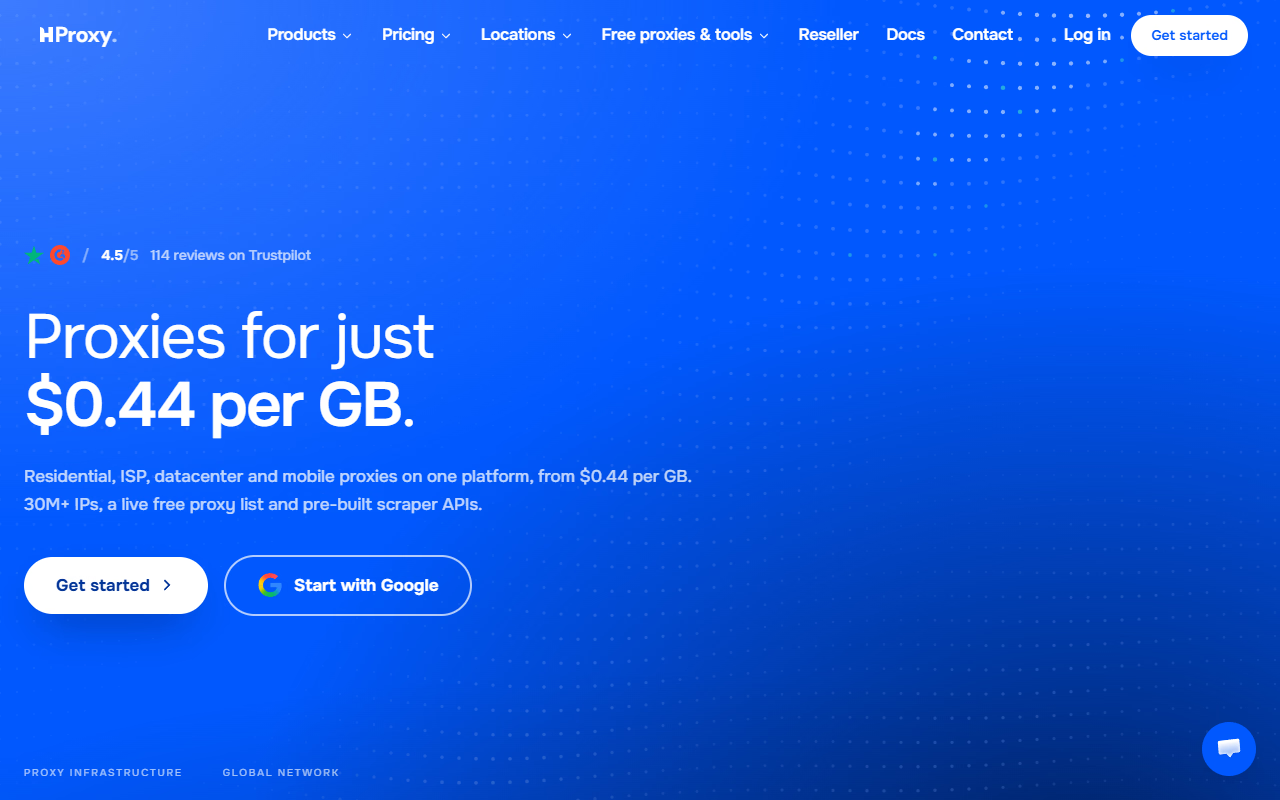
HProxy (hproxy.com) sells residential proxies from $0.44 per GB, plus ISP, datacenter, IPv6 and mobile proxies and prebuilt web scraper APIs. Companies, developers and agencies route their traffic through real IP addresses in more than 200 countries. The service is operated by Obsidian UG (haftungsbeschränkt), a registered German company based in Herford.
HProxy also runs a free proxy list, checked around the clock: HTTP, HTTPS, SOCKS4 and SOCKS5 proxies with country, anonymity, latency and uptime on every row, at hproxy.com/free-proxy-list, with a keyless API and a copy on GitHub (github.com/hproxy-com/free-proxy-list).
WHAT WE SELL AND WHAT IT COSTS
Every figure below is the live rate on hproxy.com's product pages (read again on 2026-10-07), in US dollars.
Residential proxies (rotating): from $0.50 per GB, falling to $0.44 per GB from 2,000 GB. Real home IP addresses that rotate on every request, with country targeting and sticky sessions.
Residential Premium: $1.49 per GB. The same network with ISP (ASN), state and city targeting, sticky sessions of up to 24 hours and priority routing. This is the tier for targets that check more than the country.
ISP proxies: $0.65 per GB rotating, or $2.50 per IP for one week as a static dedicated address ($2.70 for a month, $8.10 for three months). Static addresses registered to consumer internet providers, so a target reads them as residential while you keep one fixed IP. The upstream network passes ports 80 and 443 only.
Datacenter proxies (IPv4): $1.34 per IP for one week as a static address. The fastest product we sell, measured across our own fleet at a median of 115 Mbit/s and 33 ms.
IPv6 proxies: from $0.10 per IP for one week, or $0.12 per GB. The cheapest addresses in the catalogue. They speak HTTP and SOCKS5 and reach IPv6-enabled destinations only, so check that the target answers over IPv6 first.
Comments will be available once the project is launched.
Maker
Billal Ainaoui
HProxy is a proxy infrastructure platform offering residential, ISP, datacenter, IPv6 and mobile proxies alongside prebuilt web scraper APIs, all managed from a single balance. Residential proxies start at $0.44 per GB at the 2,000 GB+ rate, with a single gigabyte at $0.50 and no minimum order. The network spans more than 200 countries, and the service is operated by Obsidian UG (haftungsbeschränkt), a registered German company based in Herford.
Beyond paid plans, HProxy maintains a free public proxy pool — HTTP, HTTPS, SOCKS4 and SOCKS5 — checked around the clock and published to GitHub roughly every two minutes, with a keyless API and a Chrome extension for one-click connections.
Rotating IPs from real devices in 200+ countries, billed per GB with no subscription. Country targeting is available on every plan, while Residential Premium adds state, city and ISP (ASN) targeting, sticky sessions up to 24 hours and priority routing.
ISP proxies provide static addresses registered to consumer internet providers, priced at $0.65 per GB rotating or $2.50 per IP for one week as a dedicated static address. Datacenter IPv4 proxies are the fastest option, measured across HProxy's own fleet at a median of 115 Mbit/s and 33 ms.
From $0.10 per IP for one week or $0.12 per GB, these are the cheapest addresses in the catalogue. They speak HTTP and SOCKS5 and reach IPv6-enabled destinations only.
116 endpoints across 23 platforms return parsed JSON from a single REST call, billed from $3.00 per 1,000 successful calls.
Four proxy networks, a live free pool and 116 scraper endpoints — all on one balance.
That combination is unusual: most providers specialise in one proxy type or one scraping tool, while HProxy bundles residential, ISP, datacenter and IPv6 addresses with ready-made scraper APIs under a single account. The public free proxy list, refreshed roughly every two minutes and mirrored on GitHub, also lets you test the underlying infrastructure before committing to a paid plan. Reported figures include 99.3% request success, 99.2% network uptime and a 0.6s average response time.
You want residential-grade IPs with granular geo-targeting, need static ISP or fast datacenter addresses, or would rather call a parsed scraper endpoint than build and maintain your own extraction stack. The free pool and keyless API make it easy to evaluate the network first, and the per-GB pricing with no minimum order keeps entry costs low.
Other tools you might consider
ScrapeOps Proxy Tester is a technical benchmarking platform for developers, scraping teams, data providers, SaaS companies, and AI agents selecting proxy infrastructure. Submit a target URL to test 20+ residential, datacenter, mobile, Proxy API, and unblocker configurations. It measures real-world success rate, latency, reliability, bandwidth, and estimated cost, then generates a use-case-specific ranking instead of relying on generic provider claims.
Ditch your scraper. One API gives your code everything it needs from the web: structured JSON, clean markdown, cited research, and browser automation. No browser, LLM, or pipeline for you to run. Use it from the tools you already work in: an MCP server, CLI, Raycast extension, or as an Agent Skill. Grab a key and make your first call in less than three minutes. Mozilla-backed. Your data is never sold, never trained on.
Context.dev is the web context API for AI products and agents. Scrape any URL, crawl sites, turn pages into LLM-ready Markdown, extract structured data into your own schema, capture screenshots, and retrieve logos, colors, fonts, styleguides, company data, and transaction enrichment through one API. YC-backed, no card required, and built so developers or coding agents can integrate in minutes.
Convert any website into a clean, type-safe API. Use natural-language or JSON-schema prompts to extract data and get usable JSON output for RAG pipelines, sales, content aggregation, or research.
Product Keywords