What is Lizard?
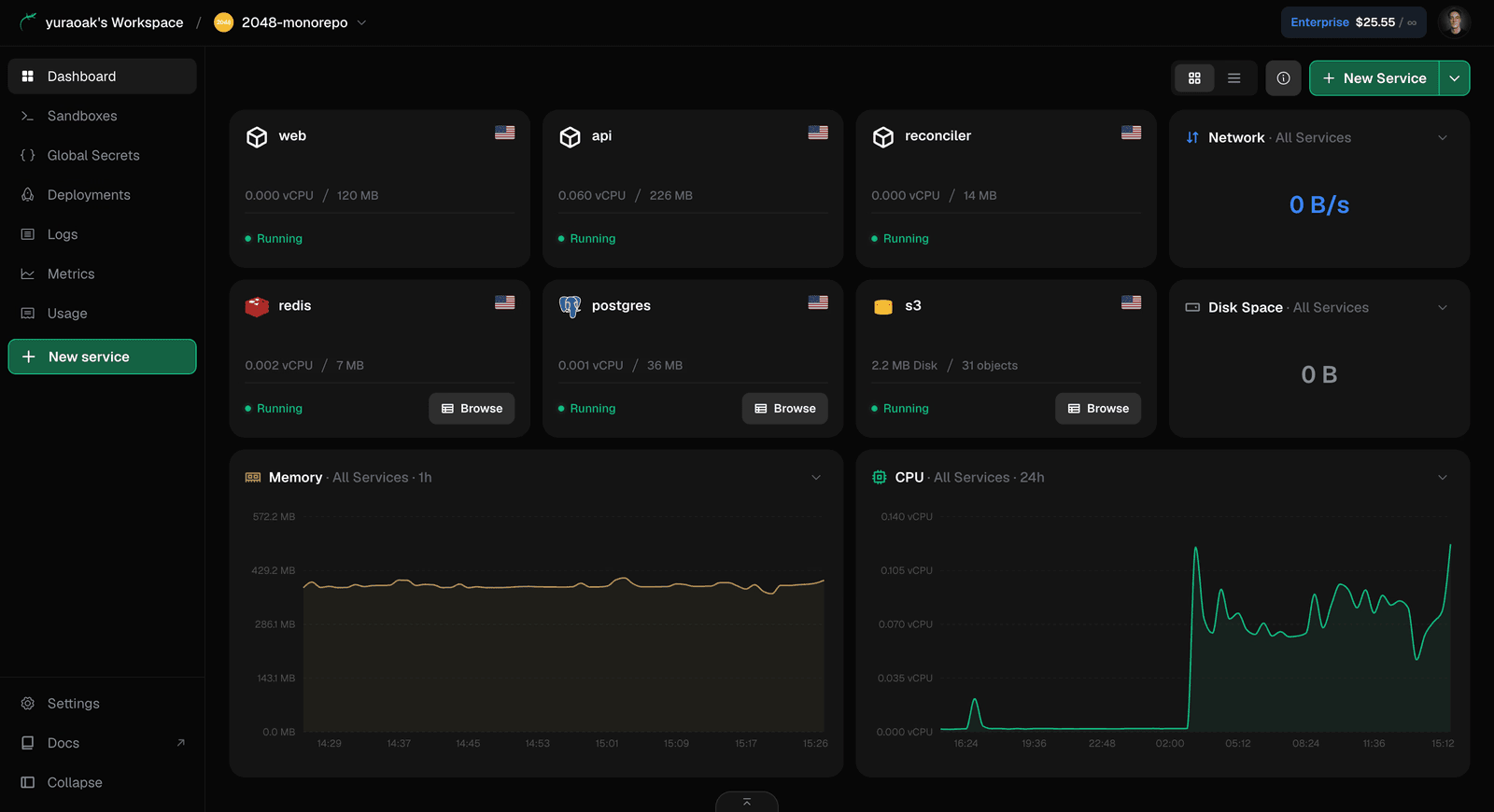
Lizard is an AI-native deployment platform built specifically for coding agents. Instead of wrestling with cloud consoles, YAML files, or infrastructure diagrams, you push your code to git and Lizard detects your stack, builds it, and ships it live. It bundles managed Postgres, Redis, and S3 into a single command, so the entire backend stack—app, database, and object storage—comes up together. The platform runs on a per-second billing model, meaning you pay only for the CPU, memory, and egress your resources actually consume, not for reserved boxes sitting idle.
Who it's for
- AI agent builders — developers who want their coding agents to deploy, debug, and iterate without human hand-holding or brittle shell-script glue.
- Solo developers and small teams — builders who need production-grade infrastructure (databases, caching, storage) without a dedicated DevOps person or a multi-hour setup session.
- Cost-conscious startups — teams tired of paying for idle cloud capacity and looking for a platform that bills on measured usage rather than instance size.
Key features
Git push to deploy
Push to your main branch and Lizard takes over. It automatically detects your stack, builds the project, and rolls it out to a live environment. No build pipelines to configure, no deployment scripts to maintain—just a push and a running app.
Managed Postgres, Redis, and S3 in one command
Spin up a database, a cache, and object storage with a single invocation. Lizard connects them to your app automatically, so you skip the manual wiring, environment variable juggling, and connection-string hunting that usually eats an afternoon.
Per-second billing
You pay only for active resources—CPU, memory, volumes, and egress—measured by the second. Idle apps cost a fraction of what they would on traditional providers. The platform's own comparison shows a 2 vCPU, 4 GB app with managed Postgres at $32.57/month on Lizard versus $55.66 on AWS—a 41% reduction.
Agent-first CLI with live logs and metrics
Every command outputs machine-readable JSON, designed for agent consumption rather than human eyeballs. Live logs and request metrics stream to your dashboard or straight into the CLI, so an agent can read a deploy failure, understand the cause, and fix it without pasting error text back to you.
What stands out
Focus on product, not infrastructure. Stop setting up. Start shipping.
That's not just a tagline—it's the architectural philosophy. Lizard was designed around the agent loop from day one, not adapted to it later. The machine-readable schema for every command, deploy event, and log line means an agent can autonomously deploy, observe, and repair. Combined with isolated containers per deployment and the ability to restore deleted services, it's a platform that treats the agent as a first-class user, not an afterthought.
Worth checking out if…
You're building with coding agents and want them to own the full deployment lifecycle, or you're a developer who'd rather spend your time on product logic than on infrastructure plumbing. If your cloud bill is dominated by idle reserved instances, or if you've ever lost an afternoon to "it works on my machine" deployment friction, Lizard's per-second pricing and single-command stack are worth a serious look.