

A comprehensive reference guide for technology leaders and engineers to navigate AI language models, providers, benchmarks, and tools.
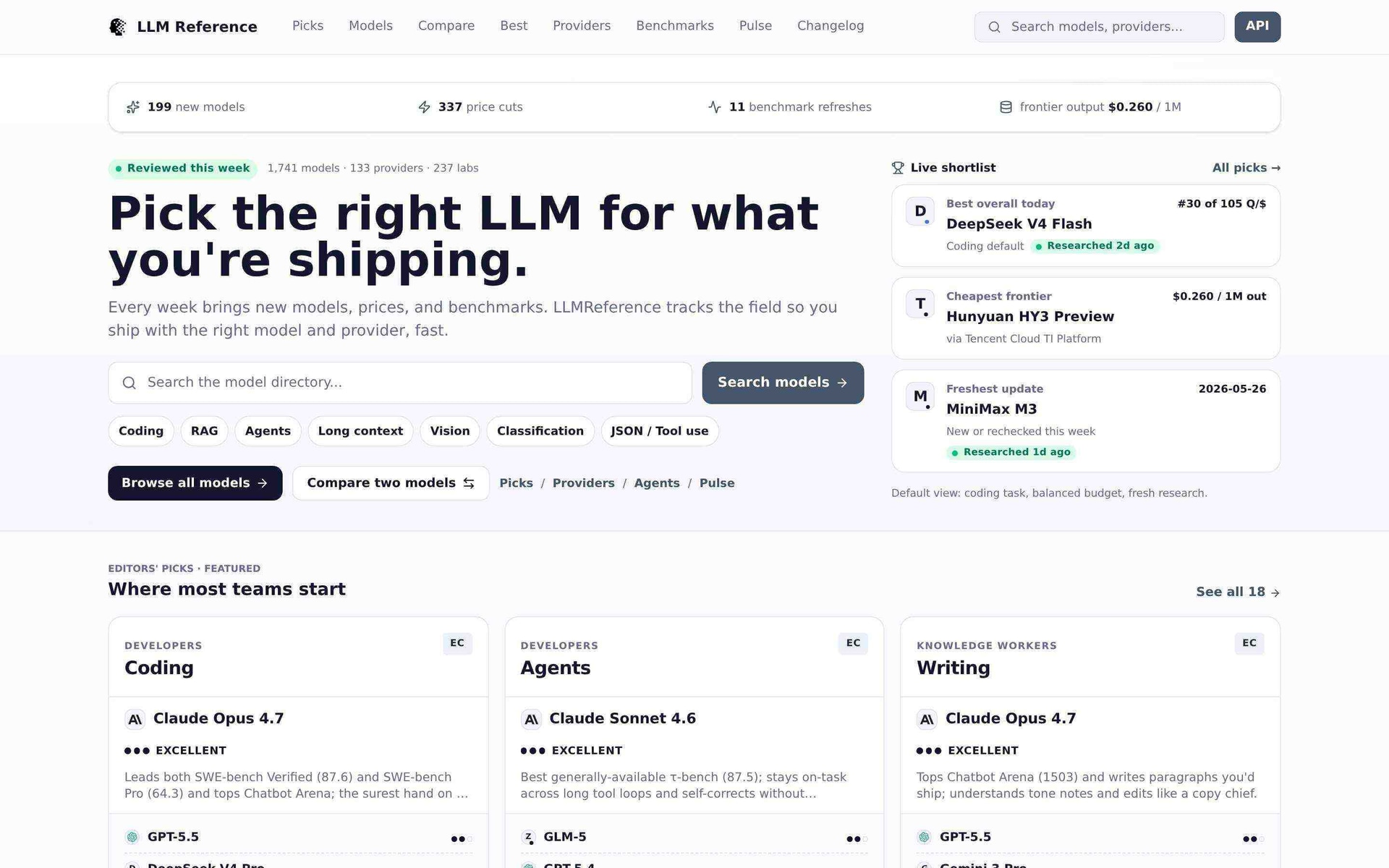
LLM Reference is a curated, continuously updated guide that helps technology leaders and engineers navigate the rapidly evolving landscape of large language models. It tracks 1,741 models, 133 providers, and 237 labs, giving you a single source of truth for choosing the right model and provider for your specific use case. Rather than drowning in weekly announcements, you get a structured view of what matters: benchmarks, pricing, and real-world performance across coding, agents, writing, research, image, and video tasks.
LLM Reference monitors 727 scores across major evaluation suites, updated weekly. You can see exactly how models perform on coding (SWE-bench Verified 87.6, SWE-bench Pro 64.3), agent tasks (Ο-bench 87.5), research reasoning (GPQA Diamond 94.2), and creative writing (Chatbot Arena 1503).
The platform surfaces verified provider price reductions and displays cost per million tokens for top-lab output. This lets you balance performance against budget without digging through separate pricing pages.
The default dashboard is organized by task β coding, agents, writing, research, image, video β with sensible defaults like . Editors' picks and featured models are highlighted for quick orientation.
A dedicated "Pulse" section summarizes what changed in the model market each week, including new model releases (e.g., MiniMax M3, StepAudio 2.5 Realtime) and verified price drops. You get a cheat sheet that condenses the noise into actionable intelligence.
LLM Reference tracks the field so you ship with the right model and provider, fast.
This isn't another static leaderboard. The product is built around the reality that every week brings new models, prices, and benchmarks β and that teams need a living reference rather than a snapshot. The task-oriented default view, combined with editors' picks and weekly pulse updates, means you spend less time researching and more time shipping. The breadth of coverage (1,741 models from 133 providers) is matched by a focus on practical, real-world performance metrics like SWE-bench and Ο-bench, not just academic scores.
You're responsible for selecting or recommending language models for production use, and you want a single, trustworthy source that tracks the full landscape β from coding and agents to image and video generation β with up-to-date benchmarks, pricing, and weekly market changes.
Other tools you might consider
Mistral 3 includes three state-of-the-art small, dense models (14B, 8B, and 3B) and Mistral Large 3 β our most capable model to date β a sparse mixture-of-experts trained with 41B active and 675B total parameters. All models are released under the Apache 2.0 license. The Ministral models represent the best performance-to-cost ratio in their category. At the same time, Mistral Large 3 joins the ranks of frontier instruction-fine-tuned open-source models.
ToolChase is an ad-free AI tool directory that helps you make smarter decisions faster. It features 650+ AI tools scored and compared across 22 categories, with over 2,000 comparison pages. The platform offers curated picks, head-to-head comparisons, and built-in free tools like an AI Prompt Generator and AI Tool Finder Quiz. Make Smarter AI Tool Decisions, Faster ToolChase provides honest comparisons with Quick Specs, persona verdicts, and scenario recommendations. It also offers a weekly newsletter with new tool reviews and honest comparisons, free forever.
GenTabs in Disco is Google Lab's newest experiment. GenTabs uses Gemini 3, turns messy browsing into custom mini-apps. It understands your open tabs and tasks, remixes them to generate interactive, personalized web applications that help you plan, learn, and create without writing a line of code.
We introduce PersonaPlex, a full-duplex conversational AI model that enables natural conversations with customizable voices and roles. PersonaPlex handles interruptions and backchannels while maintaining any chosen persona, outperforming existing systems on conversational dynamics and task adherence.
Loading commentsβ¦
Maker
Michael Grimm