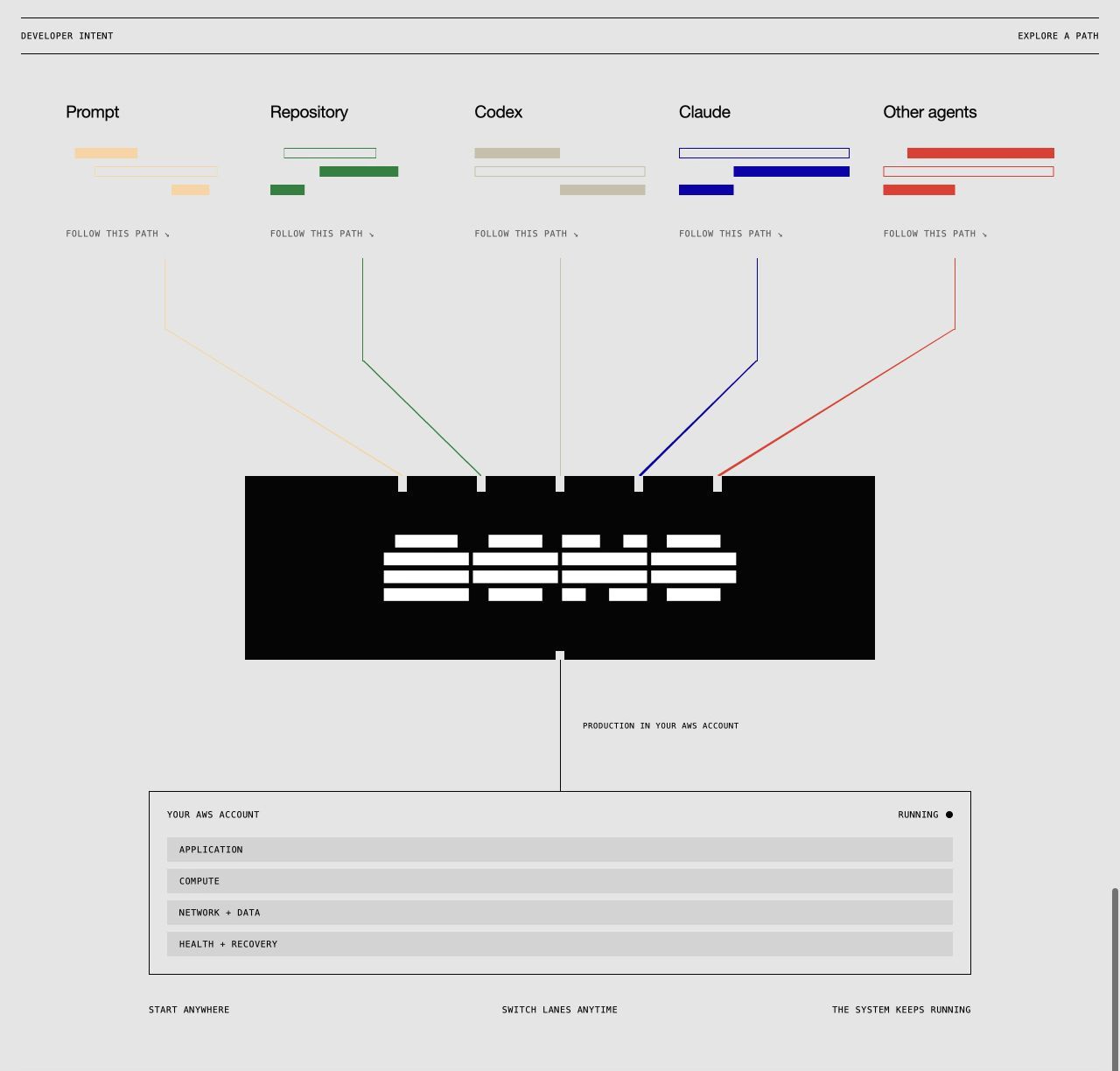
What is monolayer Autopilot?
monolayer Autopilot is a deployment and infrastructure platform that turns a simple prompt or an existing repository into a fully running, self-managed system inside your own AWS account. Instead of manually piecing together cloud setup, CI/CD pipelines, environment configuration, database provisioning, secrets management, and monitoring, monolayer reads the application's intent and handles the entire lifecycle — from determining compute, data, storage, and service relationships to validating the proposed state, provisioning infrastructure, deploying the application, and continuing to monitor runtime feedback after launch.
The platform operates on a closed-loop model: it connects intent, runtime state, and live feedback so the system can adapt and self-manage over time. Everything, including the control plane, runs inside your AWS account — meaning workloads, databases, logs, CloudFormation stacks, and billing stay under your ownership with no shared hosting, hidden markup, or platform tax.
Who it's for
- Independent developers who want to ship a full-stack application from a single prompt without spending days on cloud architecture.
- Small engineering teams that need to move from code to production quickly and want to eliminate manual infrastructure handoffs between developers and ops.
- Developers with existing repositories who are looking for a way to deploy and maintain their current codebase with automated infrastructure management and continuous drift detection.
Key features
Two entry paths
You can start from either a natural language prompt or an existing repository. monolayer accepts both paths and routes them toward the same outcome: a running system in your AWS cloud. This flexibility means you can prototype an idea from scratch or bring an established codebase without changing your workflow.
Intent-based infrastructure
Instead of designing infrastructure by hand, you describe the relationships and desired behavior of your application. monolayer determines the compute, data, storage, service, and event relationships needed, validates the proposed state, and provisions everything accordingly. This removes the need to think in terms of individual AWS resources.
Continuous runtime feedback
After launch, autopilot doesn't stop. It keeps reading runtime feedback and watching the live state of your system. This closed loop between intent, runtime, and feedback allows the platform to detect drift and keep your infrastructure aligned with what your application actually needs.
Full ownership in your AWS account
The entire platform — including the control plane — runs inside your AWS account. Application workloads, storage, logs, infrastructure resources, and billing remain under your control. There's no shared hosting model, no hidden infrastructure markup, and no platform tax on your AWS usage.
What stands out
Code or intent becomes a running, self-managed system in your own AWS account.
That single sentence captures the core value proposition: monolayer Autopilot collapses the entire gap between having an idea and having a live, operational system. Most platforms either handle deployment but leave infrastructure to you, or manage infrastructure but require complex configuration. monolayer replaces work that is normally spread across cloud setup, CI/CD, environment configuration, database provisioning, secrets, monitoring, scaling, recovery, and operational handoffs — all while keeping everything inside your own AWS environment. For developers whose code velocity exceeds their delivery capacity, this is a fundamentally different approach to getting software into production.
Worth checking out if…
You're a developer who wants to go from a prompt or repo to a running system without becoming an AWS infrastructure expert. If you're tired of stitching together separate tools for deployment, database management, monitoring, and scaling — or if you have an existing codebase that needs a more automated operational home — monolayer Autopilot is worth a serious look. It's especially relevant if you value keeping your infrastructure and data within your own AWS account rather than on a shared platform.