
Agent Insight
Evaluate agents your way
- Upvotes
- 79
Evaluate agents your way
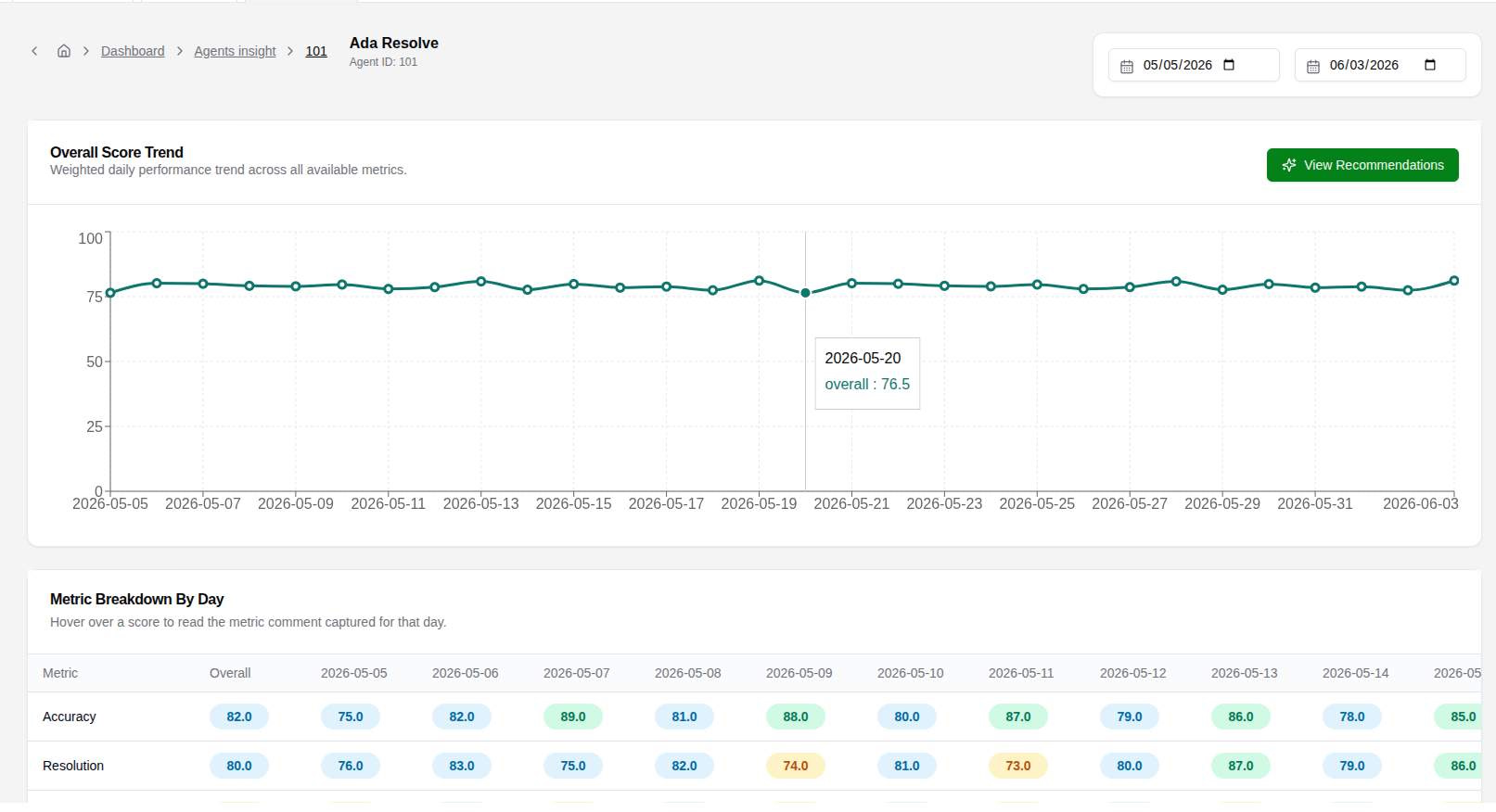
Evaluate AI and human agents against your own quality standards, by role, across every conversation — with recommendations that improve your AI.
Loading comments...

Maker
Agent Insight is a QA and insights platform for operations that run both AI and human agents. It measures and tracks the performance of every agent in your operation against the same standard, using metrics your business defines. Rather than treating AI evaluation as a black box, it turns it into a transparent scorecard: how good the AI is, how it compares with your team, whether it complies with your QA guideline, and what should improve next. Evaluation results then become signals that drive continuous, automatic improvement of the AI itself — closing the gap between "the AI is running" and "we trust what the AI is doing."
AI and human agents are evaluated on the same standard, in the same system, at the same time. Every interaction — AI-resolved, human-handled, or an escalation that passed through both — is scored against the same rubric.
Instead of a fixed scorecard, you define the metrics, because quality means something different in every operation. Resolution criteria, tone requirements, policy checks, escalation discipline, and custom dimensions all express your own definition of "good."
Your existing customer service QA guideline becomes the rubric. The AI is held to it across 100% of conversations, rather than the 1–2% sample rate typical of manual QA review.
Evaluation results become signals that drive continuous, automatic improvement of the AI itself. The platform closes the loop between measuring performance and acting on what it finds.
Measure → Compare → Improve — every AI and human agent, on the standard your business defines.
That sequence is the product's real edge. Most teams evaluate AI with one set of tools and humans with another — or don't evaluate the AI at all — which makes "is the AI better or worse than my team on this case type?" effectively unanswerable. Agent Insight makes that comparison possible on one dashboard, segmented by case type, channel, and language, so staffing and automation decisions rest on evidence rather than anecdotes.
You've deployed AI for customer support or sales and can't confidently answer how good it really is. If resolution counts tell you volume but not quality, and if your QA guideline currently covers only the human half of your operation, Agent Insight is built for exactly that gap. It's also worth a look if you want AI performance to be visible, provable, and governable — and if you'd rather define your own quality standard than fit your business into someone else's fixed scorecard.
Other tools you might consider

ClawMetry is a free, open-source observability dashboard for OpenClaw AI agents. Think Grafana, but purpose-built for AI. One command install (pip install clawmetry), zero config. Monitor token costs, sub-agent activity, cron jobs, memory changes, and session history. All in real-time with a beautiful live flow visualization. Works on macOS, Linux, Windows, even Raspberry Pi

Seekdown turns your website, docs, and knowledge base into embedded AI chatbots for your website, that answer customer questions accurately

Opttab is an all-in-one AI visibility and GEO (Generative Engine Optimization) platform designed to help brands, individuals, and businesses measure, control, and grow their presence across AI-powered search engines and LLMs such as ChatGPT, Gemini, Claude, Perplexity and other AI models. Unlike traditional SEO tools, Opttab focuses on how AI models discover, interpret, rank, and reuse your content—giving you full transparency and control over your AI-facing digital footprint.

Organizations create valuable knowledge every day, but most of it becomes fragmented across meetings, documents, calendars, project tools, inboxes, and individual memories. Decisions survive without their reasoning. Commitments are forgotten. New employees spend months rebuilding context. Generic AI assistants still begin with little understanding of the organization itself. Sentio addresses this problem by creating a living organizational memory. It gathers signals from the systems where work already happens, identifies people, projects, decisions, tasks, risks, and relationships, and connects new information to the organization’s existing history. The result is a persistent intelligence layer that becomes more useful as organizational context accumulates. Sentio combines meeting intelligence, file intelligence, a connected organizational knowledge graph, permission-aware retrieval, evidence-linked answers, and executive visibility. Before a meeting, it can surface relevant history, unfinished actions, and prior decisions. During and after the meeting, it structures transcripts, decisions, tasks, commitments, risks, and discussion context. Documents become connected knowledge rather than passive files. Authorized users can ask questions about the organization and inspect the original evidence behind each answer. Sentio is designed to improve human judgment rather than replace it. It helps teams find context, understand why decisions were made, preserve knowledge through change, and act with greater clarity.
Loading comments...